

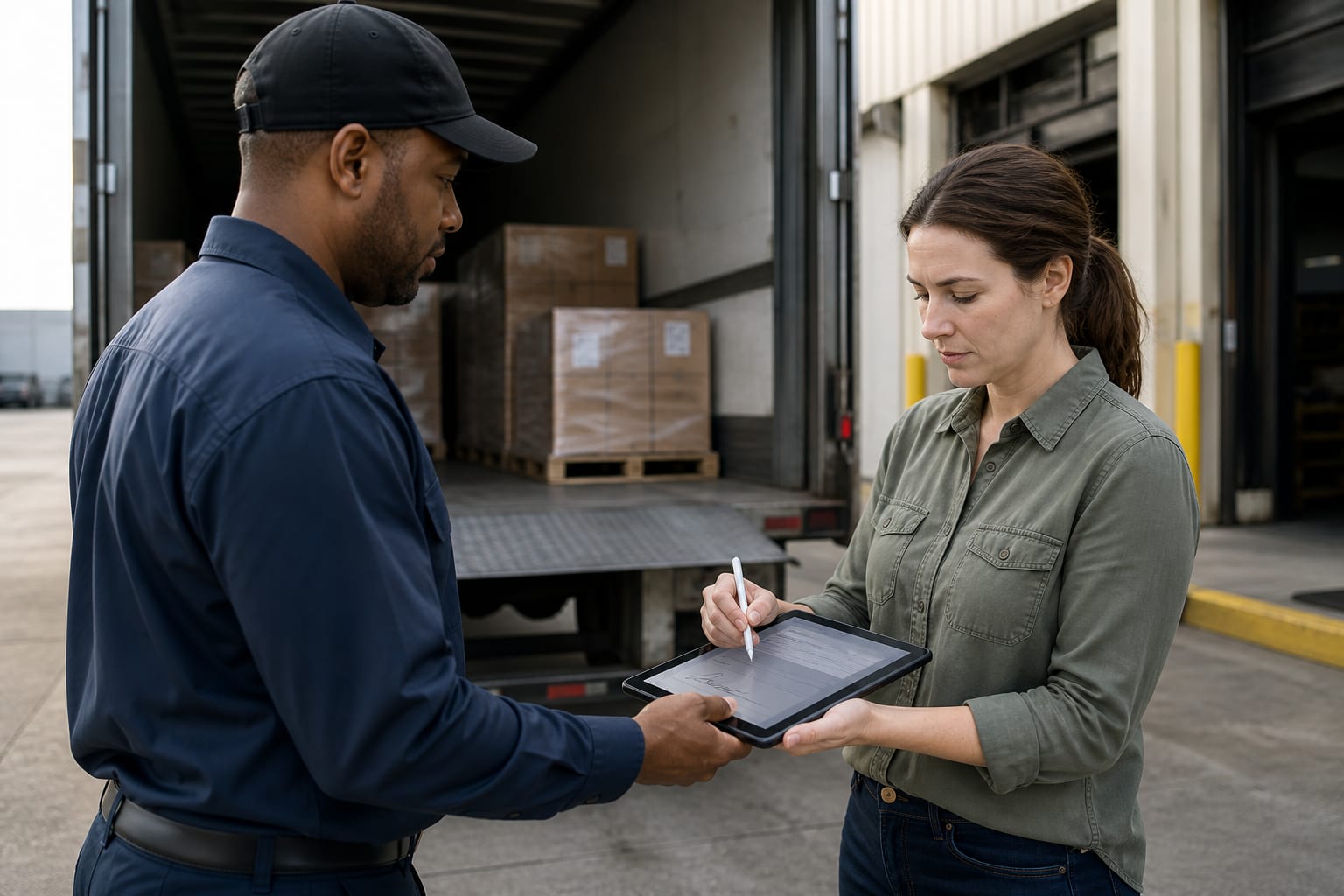
What counts as proof of delivery that survives a deduction, an insurance claim, or a lawsuit, and why most of what circulates in Mexico does not.
The driver sends the photo at 4:12 p.m. You can see a delivery note with a blue stamp, partly cut off, and a signature that could be anyone’s. The WhatsApp group says “delivered.” Traffic closes the trip. Thirty-eight days later the customer deducts 14 pallets from the commercial invoice for “shortage on the receipt.”
Traffic looks for the photo. Finds it. It has no readable date, it does not say how many pallets were received, and the stamp does not identify the warehouse. The customer wins without an argument.
Piece 5 of 10 in the trip-file series. See all ten · Previous · Next
- Stamps: who, what, when, and how
- 4
- Liable from receipt until delivery
- Art. 66
- Reasonable window for proof to reach traffic
- 24 h
The country of the CFDI and the blurry photo
Mexico digitized the invoice before almost any other country. Proof that the goods arrived is still a piece of paper photographed with a phone. That asymmetry is not anecdotal. It is why customers who used to pay in 30 days now pay in 60 or 90, with late disputes and unauthorized discounts, as T21 reported.
The law is stricter than the practice. The Roads Law defines the carta de porte as the legal title of the contract between shipper and carrier, and disputes that arise from the transport are decided by its contents. Article 66 makes the carrier liable for loss and damage from the moment it receives the freight until it delivers it to the consignee.
That sentence has two ends. Receive and deliver. Both need proof. The carrier almost always has proof of the first, because the shipper asks for it. It almost never has proof of the second in a form that can be defended, because nobody asks for it until it is already late.
The four stamps
Proof of delivery works when it answers four questions with no help from anyone. Who received. What they received. When. And in what condition. If one of the four needs someone to explain it on the phone, it is not proof. It is testimony.
Who. A readable name and signature of who received, and the warehouse stamp that identifies it. A signature with no name is a scribble. A stamp with no company name is ink.
What. Quantity received, in the same unit as the purchase order. Pallets, cases, pieces, or kilos. If the delivery note says 26 pallets and the receipt does not say how many were accepted, the customer can say 12 and nobody can contradict them.
When. Date and time of receipt, not of arrival. Insurers require that damage or shortages be noted on the receiving document with the date. With no date on the document, the claim is born dead.
How. Remarks. “No exceptions,” or “2 cases damaged,” or “received subject to count.” That last line is the most dangerous sentence in Mexican trucking, because it leaves the door open to any later deduction. If the customer writes it, the carrier should require that the count happen at the dock and close on the same document.

The fifth witness
The four stamps live on paper. There is a fifth that does not. GPS records when the unit entered the destination geofence and when it left. It does not prove what was unloaded, but it proves the unit was there, for how long, and that the time on the delivery note is compatible with reality.
A photo stamped at 4:12 of a tractor that, according to the GPS, left the destination at 2:50 is a photo that explains a lot of things. None of them good.
What WhatsApp can be
WhatsApp is not the problem. The problem is the photo with no structure. A message with date, time, plates, delivery-note number, quantity received, and the full image of the stamped document is reasonable proof. It is, in fact, better than the paper original that reaches the office eight days later with the driver.
The difference between the two photos is not technology. It is a capture format the driver follows every time, and someone who reviews it in the first 24 hours, while the dock still remembers the trip.
What to ask for, and when
- Before the trip. The shipping order should specify which receiving document is expected and by when it must reach traffic. 24 hours is reasonable. 8 days, the usual, is too late.
- At the dock. The driver does not leave without the four stamps. If the warehouse refuses to write the quantity, the driver writes it and photographs it next to the refusal.
- When the trip closes. Someone matches the photo to the delivery note, the purchase order, and the GPS before marking the trip delivered. It is one minute. It saves thirty-eight days.
- When filing. The proof stays tied to the trip number, the carrier invoice, and the Carta Porte complement. Proof you cannot find is proof that does not exist.
Start this week
Take the last ten proofs of delivery you have at hand. Score them on the four stamps. The ones that pass all four are the only ones that would survive a deduction. The rest are photos.
The 14 pallets were deducted. The freight arrived complete. The proof did not.
Key takeaways5 points
- Mexico digitized the invoice before almost any other country.
- Proof of delivery works when it answers four questions with no help from anyone.
- The four stamps live on paper.
- WhatsApp is not the problem.
- Before the trip.
Assemble the file before you pay
Frequently asked questions
Not if it does not answer four questions with no help from anyone: who received, what they received, when, and in what condition. A signature with no name, or a stamp with no date, is testimony.
Article 66 makes the carrier liable for loss and damage from the moment it receives the freight until it delivers it. Receiving and delivering both need proof. Proof of origin almost always exists. Proof of destination almost never exists in a form you can defend.
Yes, when the message carries date, time, plates, delivery-note number, quantity received, and the full image of the stamped document, and someone matches it to the order and the GPS in the first 24 hours.