

How to defend an invoice against grocery-retail deductions for a short delivery, a missed appointment, or a delay, with the trip file and not with emails.
The grocery supplier receives the payment complement. Money is missing. The detail shows three chargebacks. One for “appointment missed,” one for “pallets with gaps,” one for “incomplete cases.” They add up to 2.3% of the invoice. Commercial asks traffic what happened on those three trips.
Traffic does not know. They were seven weeks ago. The driver no longer works there. The carrier says it delivered complete. And the WhatsApp photo does not say how many cases were received.
Piece 6 of 10 in the trip-file series. See all ten · Previous · Next
- Evidence is born here. By day 2 it degrades
- Day 0
- Days later the chargeback arrives
- 30 to 60
- Pieces in the file that answers the deduction
- 7
Retail plays with written rules
Grocery chains do not improvise their deductions. They publish them. One large Mexican chain’s supplier manual sets a penalty charge for missed deliveries, late appointments, pallets with gaps, mixed-SKU cases, and incomplete cases, applied on the next payments. The storage chargeback starts from the notice at the store.
In the United States the model is harder and better known. Walmart fines 3% of the cost of the goods on cases that do not arrive on time or complete under its OTIF program, with targets that have risen over the years. That 3% is deducted before the supplier sees the payment. In Mexico the chains copy the mechanism with their own percentages.
Retail’s logic is coherent. It buys thousands of SKUs from hundreds of suppliers. It cannot investigate every delivery. So it deducts first and leaves the supplier the burden of proving otherwise. Whoever cannot prove, pays.
The problem is not the deduction. It is the calendar
The deduction arrives between day 30 and day 60. The evidence that would contradict it is produced on day 0 and starts to degrade on day 2. The driver changes routes, the dock forgets, the GPS rotates its history if nobody downloads it, and the stamped paper travels eight days in the cab.
T21 documented the pattern. Customers who paid at 30 days now pay at 60 or 90, with late disputes and unauthorized discounts. And a recent legislative initiative documents collection cycles of 90, 120, and up to 180 days in the sector. The dispute arrives when the trip is already archaeology.
There are two ways to win that race. Argue faster, which does not depend on the supplier. Or keep the evidence on day 0 as if the deduction had already arrived, which does.

The three deductions and what takes them apart
Missed appointment. The chain records the time the unit checked in at the gate office. The GPS records the time it entered the geofence. If the tractor was at the door 40 minutes before the appointment and the gate office logged it an hour later, the deduction does not stand. Without GPS, it always stands.
Incomplete cases or a shortage. Three documents cross here. The purchase order, the delivery note the freight left with, and the dock receipt with the quantity accepted. If the receipt has the quantity and it matches the delivery note, the shortage happened inside the distribution center. If the receipt says “subject to count,” the supplier already lost.
Pallets with gaps, the wrong pallet, not enough stretch wrap. These are load-quality deductions. The only defense is a photo of the freight at origin, with a date, before the trailer is closed. It is a thirty-second habit almost no operation has.
The file that wins
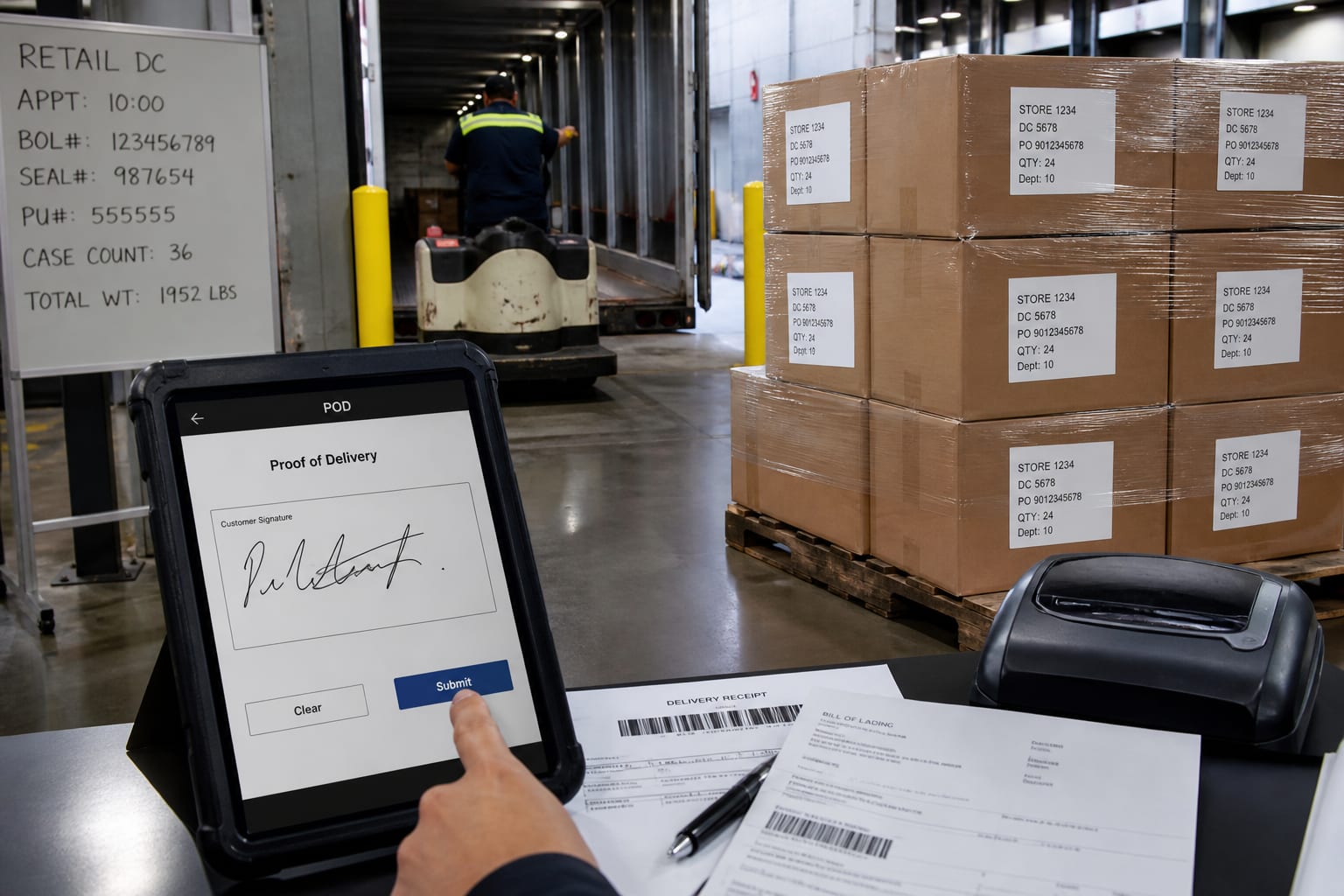
A deduction is fought with a file, not with an email. The file for a grocery trip has seven pieces, and all of them exist on day 0.
- Purchase order with appointment, quantity, and window.
- Delivery note or commercial invoice with quantities and SKU.
- Photo of the freight at origin, with date and plates.
- Carta Porte complement for the trip.
- GPS report with entry and exit times at the distribution-center geofence.
- Dock receipt with the four stamps (who, what, when, how).
- Exception log, if there was a partial refusal, a wait, or an appointment change.
With the seven pieces, the answer to a chargeback is a one-page document and an annex. Without them, it is a commercial negotiation in which the supplier is asking for a favor.
Who should build the file
The uncomfortable answer is that it is not the carrier. The carrier collects the freight and leaves. The deduction hits the supplier, on its goods. The incentive to build the file sits in the shipper’s traffic team, or in the logistics operator that moves the freight for them.
That opens an opportunity almost no logistics operators takes. Deliver to the customer, together with the freight invoice, the complete trip file. The logistics operator that does this stops selling kilometers and starts selling the ability not to lose the 2.3%.
Start this week
Take the chargebacks from the last three months of your largest grocery customer. Add them up. Divide by the billing for the period. That percentage is what it costs not to have a file. Then take three of those notes and try to assemble the seven pieces. The ones you cannot find are the ones you start capturing on Monday.
The three chargebacks were paid. None was argued. There was nothing to argue with.
Key takeaways5 points
- Grocery chains do not improvise their deductions.
- The deduction arrives between day 30 and day 60.
- Missed appointment.
- A deduction is fought with a file, not with an email.
- The uncomfortable answer is that it is not the carrier.
Assemble the file before you pay
Frequently asked questions
The chargeback arrives between day 30 and day 60. The evidence that would contradict it is produced on day 0 and starts to degrade on day 2: the driver changes routes, the dock forgets, and the GPS rotates its history if nobody downloads it.
With the GPS. If the unit was inside the geofence before the appointment and the gate office logged it later, the deduction does not stand. Without GPS, it does.
Purchase order with the appointment, delivery note or commercial invoice, photo of the freight at origin, Carta Porte complement, GPS in and out, dock receipt with the four stamps, and an exception log if there was an incident.