

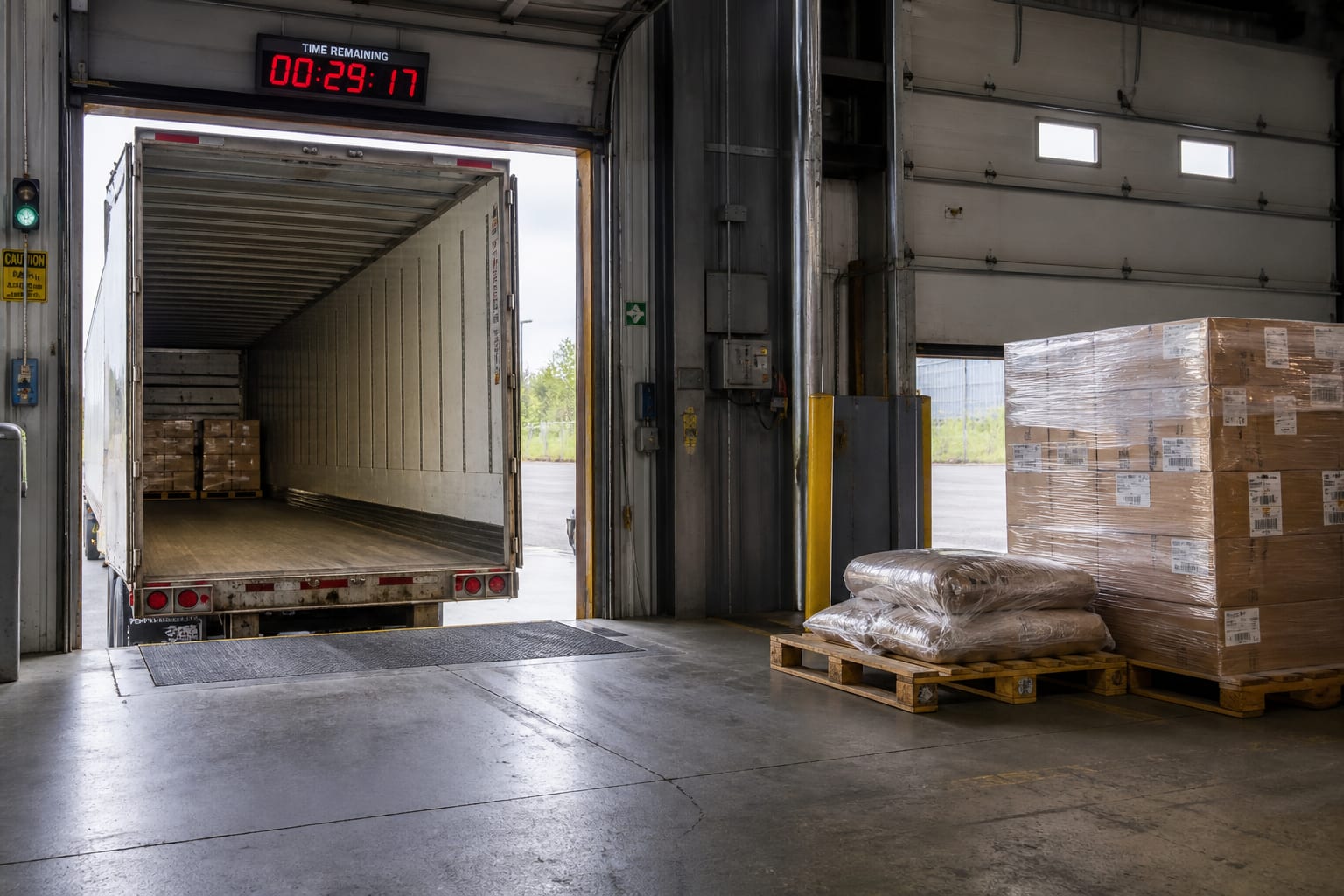
The real cost of detention on the Mexico–U.S. corridor, and why the number on the invoice is almost never the one the GPS recorded.
The tractor arrived at the distribution center at 6:40 a.m. The appointment was at 7. They unloaded it at 2 p.m. The driver wrote eight hours on his sheet. The warehouse logged that the unit “arrived late.” The carrier billed six hours of detention. The shipper paid four, to avoid the fight.
Four versions of the same morning. Only one was verifiable, and nobody looked it up.
Piece 2 of 10 in the trip-file series. See all ten · Previous · Next
- Stops with detention, ATRI 2024
- 39.3%
- Stopped T3S2, IMT 2024, driver excluded
- MXN 302/h
- Most common free time: load and unload
- 2 + 2 h
The cost nobody legislated and everybody pays
In the United States detention is measured like few other things in trucking. The most complete study, published by ATRI in 2024, found that drivers suffered detention on 39.3% of their stops and that on one in ten the wait exceeded two hours. Each driver lost between 117 and 209 hours a year waiting at a dock.
The aggregate cost: USD 3.62 billion unreimbursed and USD 11.5 billion in lost productivity in 2023 alone. In refrigerated freight, detention hits 56% of stops. And the fact that explains Tuesday’s invoice: most fleets do not measure real detention time at each stop. They bill what the driver remembers.
In Mexico the phenomenon is the same and the data is scarcer. In 2024 the Mexican Transport Institute published the most solid reference. A stopped T3S2 tractor costs MXN 302 per hour and MXN 7,253 per day in immobilized capital and fixed costs alone, not counting the driver or the freight that did not move. A T3S2R4 full rises to MXN 405 per hour.
The same study calculated that delays on fifteen trunk corridors cost trucking MXN 169 billion in 2023. The Mexico–Nuevo Laredo axis concentrates 127 million delay-hours a year.
The port as a laboratory
Ports are the only place where Mexico measures waiting with a public clock. In July 2026 a tractor took on average 12 hours 50 minutes to be served in Manzanillo and 11 hours 58 minutes in Lázaro Cárdenas. COMCE Northeast turned those hours into money: MXN 44.4 million a day across four ports.
Two years earlier, T21 documented that entering the port and pulling a container took 5 hours 21 minutes, with a direct cost of MXN 6,000 to 8,000 before the trip even started. The wait doubled. So did the cost.
What the port teaches is simple. When there is a public clock, there is a number, a responsible party, and a negotiation. When there is not, each side invents its own.
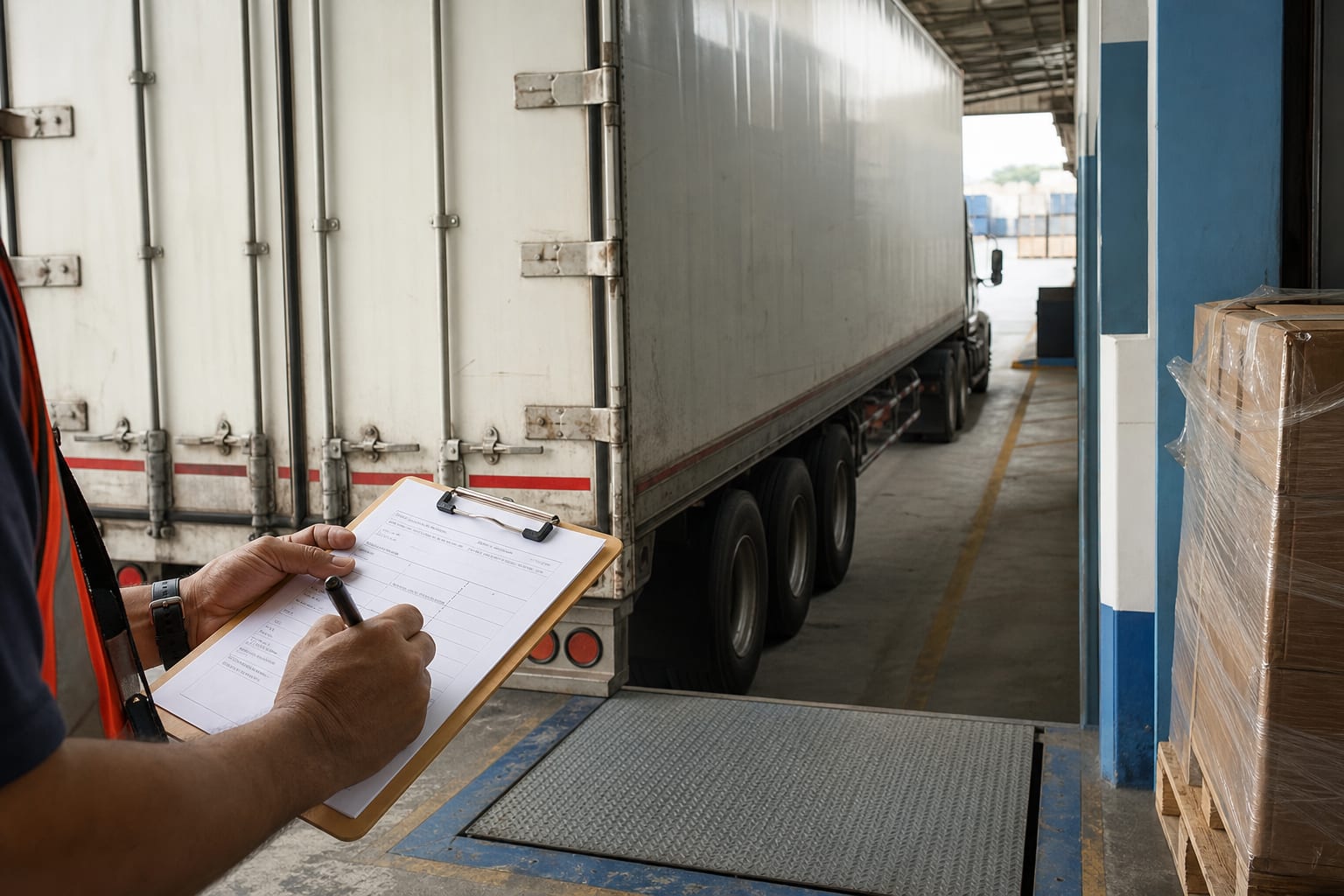
The two clocks
At a private distribution center there is no public clock. There are two private clocks that almost never agree.
The dock clock belongs to the warehouse. It records the time the unit checked in at the gate office, not the time it arrived at the door. It records the time a door was assigned, not the time unloading finished. Two or three hours that nobody counts live in those gaps.
The GPS clock belongs to the unit. It marks entry into the destination geofence and the exit. It does not know about appointments or blame. It only knows how long the unit was there.
Real detention is a subtraction. Geofence exit time, minus entry time, minus the free hours that were agreed. In Mexico the most common convention is two free hours to load and two to unload, though each contract can set another. Everything beyond that is detention. Everything inside it is not.
What to bill, what to pay, and with what proof
The carrier’s question is how much to bill. The shipper’s is how much to pay. Both have the same answer when there is evidence.
- Arrival time is the GPS time, not the gate-office time. If the warehouse took ninety minutes to register a unit that was already at the door, those ninety minutes are detention.
- The appointment defines responsibility, not the detention. A unit that arrived late to its appointment and waited five hours may have no right to bill. That is argued with the appointment time on the order and the arrival time on the GPS. Not with anyone’s memory.
- The hourly rate has to be on the shipping order. If it is not, the most defensible reference is the IMT hourly cost by configuration, MXN 302 for a T3S2. A charge of MXN 800 per hour with no contract behind it is a negotiation, not an invoice.
- Detention measured in days has another name. After 24 hours it becomes an overnight layover or storage on wheels, and the shipper has the right to ask why nobody gave notice in time.
- An authorization is worth what its record is worth. A “wait, they’re unloading you” said on the phone does not exist. The same message on WhatsApp or email, with a time, does.
The part that costs more than the detention
ATRI found that 52% of truckload drivers ran out of hours of service because of a detention. Mexico does not regulate hours of service with the same hardness, but it has something worse. Drivers are scarce.
Every hour a tractor spends at a dock is an hour it is not on the road, in a country where 90,000 trucks are already parked for lack of a driver, according to Canacar. Detention is not paid only on the invoice. It is paid in the trip that did not happen the next day.
Start this week
Ask your GPS provider for a geofence dwell report on the last thirty trips to your largest customer. Subtract two hours from each. Compare the sum with what was billed and what was paid as detention in that period. Three different numbers will come out.
The one the GPS says is the only one you can defend at a table.
Key takeaways5 points
- In the United States detention is measured like few other things in trucking.
- Ports are the only place where Mexico measures waiting with a public clock.
- At a private distribution center there is no public clock.
- The carrier’s question is how much to bill.
- ATRI found that 52% of truckload drivers ran out of hours of service because of a detention.
Assemble the file before you pay
Frequently asked questions
It is a subtraction: geofence exit time minus entry time, minus the free hours that were agreed. In 2024 the IMT estimated a stopped T3S2 tractor costs MXN 302 per hour and MXN 7,253 per day, in immobilized capital and fixed costs alone.
No. Arrival time is the GPS time. If the warehouse was slow to register a unit that was already at the door, that time is detention.
The most common convention is two hours to load and two to unload. Each contract can set another. Whatever exceeds that window, on the GPS, is detention.
In 2024, detention on 39.3% of stops and between 117 and 209 hours a year per driver waiting. Most fleets do not measure real time at each stop: they bill what the driver remembers.